









CEIA Underwater Metal Detector Array
Underwater Metal Detector Array CEIA
- Greater survey width, for each single run, to reduce the number of passages required to cover a given area, thus decreasing the survey time needed.
- Determination of the position of the objects found within the coil.
- Data on the size of the object.
- Data on how deep the object is buried
Product Specifications
| Applications | Underwater mine detection / UXO and ERW detection / underwater security surveys / submerged-object detection / naval and defense applications / seabed surveys |
|---|---|
| Buoyancy | Antenna and support weight is compensated underwater through selected buoyant materials/ sealed cavities and optimized density distribution |
| Communication | RS-485 balanced asynchronous serial communication to the surface |
| Control Electronics | Housed in an AISI 316 stainless-steel enclosure |
| Detection Technology | Electromagnetic induction with a multi-zone linear array antenna |
| Detection Windings | 12 independent electromagnetic transmission and receiving windings |
| Detection Zones | 5 independent detection zones arranged in a single line array |
| Electromagnetic Design | Precisely balanced inductive system optimized for high signal-to-noise ratio |
| Electronics Protection | Control enclosure is resin-filled to prevent water infiltration |
| Environmental Immunity | Designed to minimize interference from ROV motors/ lighting/ electronics and nearby metallic structures |
| Installation | Designed for integration with an ROV rather than conventional diver-held operation |
| Key Advantage | Provides wider-area underwater detection while also supplying information about the approximate position/ size and depth of detected metallic targets |
| Manufacturer | CEIA |
| Maximum Operating Depth | Up to 300 m |
| Mechanical Immunity | Antenna construction designed to reduce effects from static or vibrating metallic structures around the ROV |
| Pressure Resistance | Watertight antenna system designed for operation at 3 MPa pressure |
| Primary Application | Underwater metal detection and survey operations using remotely operated vehicles (ROVs) |
| Product Name | CEIA Underwater Metal Detector Array |
| Product Type | Advanced Underwater Metal Detection System with Linear Array Antenna |
| ROV Integration | Mechanical support with two arms for attachment to an ROV |
| Search Antenna | Planar antenna measuring 2 m wide × 1 m long |
| Survey Advantage | Wider search coverage reduces the number of ROV passes required to survey a given underwater area |
| Survey Width | 2 m antenna width provides substantially wider coverage per ROV pass than a single-zone underwater detector |
| Target Information | Provides data for determining target position/ estimated target size and detection depth |
CEIA Underwater Metal Detector Array
The success of the Linear Underwater Metal Detector resulted in the pursuit of research and development of an even more advanced metal detector equipped with a linear array antenna which would allow:
- Greater survey width, for each single run, to reduce the number of passages required to cover a given area, thus decreasing the survey time needed.
- Determination of the position of the objects found within the coil.
- Data on the size of the object.
- Data on how deep the object is buried
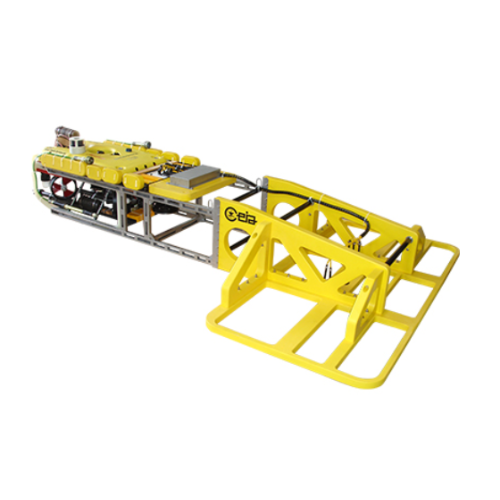
This second model was also designed for operations in depths up to 300 m. The antenna consists of five detection zones arranged in a single line array.
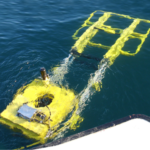
The planar search antenna is two meters wide by one meter long and equipped with a mechanical support consisting of two arms with which it is attached to the ROV.
The antenna consists of 12 independent transmission and receiving windings for the electromagnetic field in order to satisfy the detection needs and to provide sufficient data to determine position, dimension and depth of the target.
The fundamental characteristics of the antenna system needed to achieve the best signal/noise ratio and to be able to operate with high dependability are rigidity, water tightness (@ 3 MPa pressure) and the precise electromagnetic balancing of the inductive system.
During design and construction, particular care was also given to isolate the antenna from external interference sources, which could be electromagnetic (motors, lighting systems, electronics on the ROV) or mechanical (static or vibrating metallic structures in the vicinity).
The final design of the Metal Detector Array was preceded by a series of measurements conducted on the surface with the purpose of verifying its electromagnetic environmental compatibility. In addition to the optimization of the inductive system, the distance of the planar array to the ROV and the type of materials used were selected in a way so they would not create any increase in the electronic background noise of the Metal Detector.
The electronic control unit is housed in a AISI316 Stainless Steel enclosure similar to the one used in the first single zone device. The enclosure is equipped with a flange for attachment to the ROV. To prevent any infiltration of water, the enclosure is filled with resin.
Under water, the total weight of the antenna system including its support is compensated by the buoyancy of the materials selected and their density distribution as well as the number and location of sealed cavities inside the stainless steel support framework.
The communication with the surface is achieved by a type RS-485 balanced asynchronous serial connection.